
|
|
||||||||||||||||||


| 2026-2027 Electoral Calendar, latest official version |

|
 |
|
|
|
|
|
|
|||||
|
|
Haiti's Prime Minister's address to the UN General Assembly (video speech) 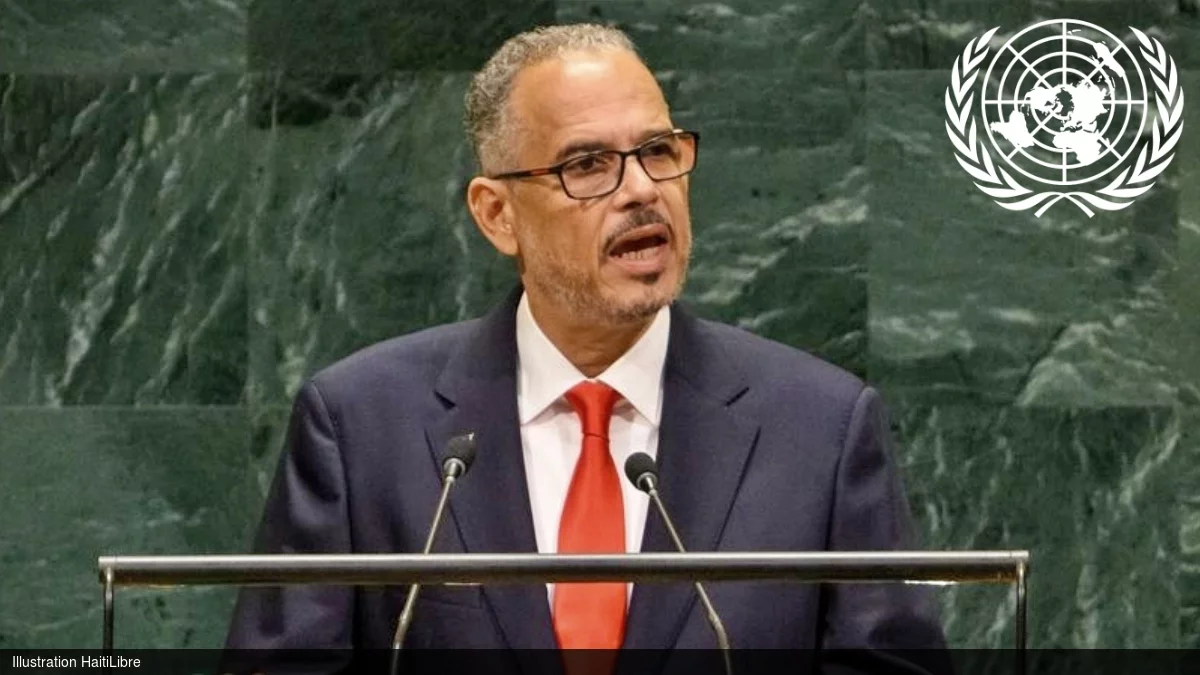
On Friday, September 25, 2026, addressing the 81st session of the United Nations General Assembly in New York, Haitian Prime Minister Alix Didier Fils-Aimé summarized the delicate balance underpinning his strategy : calling for increased international support while simultaneously promising to empower the Haitian state to ensure its own security, emphasizing, "Haiti is not asking the world to save it. The Caribbean island is asking Haiti to help it save itself." He expressed Haiti’s gratitude to its partners, including the United Nations, the United States, Canada, France, Mexico, CARICOM, the OAS, and the European Union, while also calling for the full deployment of the Gang Supression Force (GSF). Haiti calls on the world "to stand by its side as it takes back control of its destiny," the Prime Minister stated. This ambition clashes with a far harsher reality : gangs still control the vast majority of Port-au-Prince and its strategic thoroughfares, while violence is spreading to regions that were long relatively untouched. Operations conducted in the Haitian capital are producing some results, but they are failing to break the gangs' grip. The pressure exerted in Port-au-Prince seems to have pushed some groups toward areas where the state has an even smaller presence. This phenomenon has been observed as far south as the country: as security forces attempt to retake neighborhoods in the capital, some of the violence is simply shifting. For Fils-Aimé, the solution lies first and foremost in strengthening Haitian forces so that the country can gradually become self-sufficient in terms of security. More than 2,000 police officers have already completed their training, a number he hopes to double soon, while the army has grown by 1,500 new recruits. The government now intends to train an additional 15,000 soldiers over the next three years. "Haiti’s long-term security must rely on the capabilities of the Haitian state," he insisted. But the Prime Minister is simultaneously calling for the renewal of the mandate of the Gang Supression Force (GSF), approved by the Security Council in September 2025, with a capacity of up to 5,500 police and military personnel, to succeed the previous multinational mission led by Kenya, which never reached its expected strength. However, the FRG is still far from its 5,500 personnel. "A mandate is not enough. We need personnel. We need resources. We need the determination to see this through," the Prime Minister emphasized. The other front is outside Haiti. The weapons that fuel the gangs are imported clandestinely, despite the international embargo. "The weapons that kill Haitians [...] are not produced in Haiti," Fils-Aimé reminded everyone, calling for the dismantling of the networks that supply the criminal groups. This reconquest must serve a political objective: the organization of the first national elections since 2016. The first round of the presidential and legislative elections is scheduled for December 13, if the security situation allows. He assures that the current transition "will end with a ballot at the ballot box." He notes that two specialized judicial centers have been created and that new penal and criminal procedure codes are to come into effect on January 1st, 2027. Security, justice, and elections are thus presented as the three pillars of a single reconstruction of the state. The economy remains. Fils-Aimé wants to shift his country "from aid to investment, from production assistance to dependence on partnerships." Here again, ambition clashes with urgency. Approximately 6.4 million Haitians are in need of humanitarian aid, and nearly 1.5 million have been displaced. This is the crux of the challenge presented in New York. Building a state capable of gradually becoming self-sufficient, even though its immediate survival still depends on it. "We have proven to the world that freedom is possible," Fils-Aimé concluded. More than two centuries after independence, Haiti must now demonstrate its capacity to reclaim its own territory. HL/ HaitiLibre
|
|









|
|
Why HaitiLibre ? |
Contact us |
Français
Copyright © 2010 - 2026 Haitilibre.com |