
|
|
||||||||||||||||||


| New revised electoral calendar (Oct. 28, 2026) |

|
 |
|
|
|
|
|
|
|||||
|
|
Haiti - Les Cayes : Launch of training on the new Penal Code and Code of Criminal Procedure 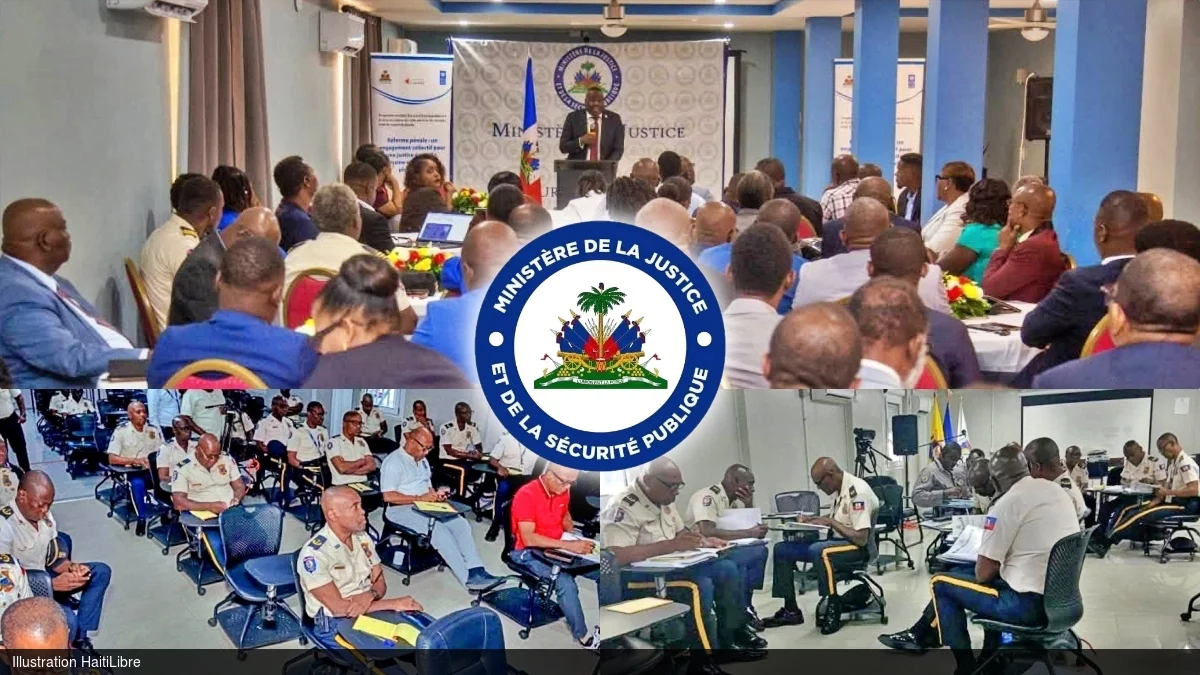
On Tuesday, November 3rd, 2023, Minister of Justice Patrick Pélissier officially launched a national training program for judicial stakeholders regarding the new Penal Code and Code of Criminal Procedure in the country’s third-largest city. Held at the Kayah-Belah Hotel, the ceremony marked the beginning of a training process designed to prepare various actors within the judicial system for the implementation of these new legal instruments, which are set to take effect on January 1st, 2027. In his remarks, Minister Pélissier emphasized the need to move beyond the limitations of the previous penal framework and to place human dignity at the heart of the administration of justice. He noted that the January 1st, 2027, deadline announced by the Prime Minister at the United Nations last September requires methodical preparation by all involved parties. He highlighted the key innovations introduced by the new codes, stressing the importance of legal professionals fully grasping these changes. The program, which aims to strengthen the capabilities of judges, government prosecutors and their deputies, lawyers, court clerks, and police officers, is intended to ensure a harmonized application of these new legal provisions. The Minister noted that this reform is part of an effort to modernize Haitian penal legislation, some of which dates back nearly 200 years. Sabine Boucher, President of the Commission for the Implementation of the New Codes, participated in the event, which signaled the start of the preparation process for judicial stakeholders regarding this significant reform. She underscored the broader significance of this initiative, noting that it goes well beyond the simple transfer of knowledge. It aims to foster a genuine transformation of professional practices, strengthen coordination among magistrates, public prosecutors, and the National Police, and promote a culture of legality, accountability, and the protection of fundamental rights. The first phase of this training program is taking place from November 3rd to November 20, 2026, in the Southern Department. The program includes six training sessions, running until December 11, 2026, with the goal of training 40% of first-instance magistrates and 40% of police investigators. Activities began simultaneously in Les Cayes—involving 20 magistrates from both the bench and the public prosecutor’s office—and at the National Police Academy in Frères, in the presence of the high command of the Haitian National Police. The program will be progressively extended to include other magistrates across all levels of jurisdiction, as well as other stakeholders within the criminal justice chain. The training sessions will be led by instructors who completed a training cycle at the French National School for the Judiciary (École Nationale de la Magistrature – ENM), as well as by two of the drafters of the new codes, Jean Joseph Exumé and René Magloire. The Commission for the Implementation of the Codes is responsible for the design and pedagogical coordination of the program. Beginning in January 2027, the program will be gradually expanded to include magistrates at all levels of jurisdiction and other actors within the judicial system. HL/ TB/ HaitiLibre
|
|









|
|
Why HaitiLibre ? |
Contact us |
Français
Copyright © 2010 - 2026 Haitilibre.com |