
|
|
||||||||||||||||||


| New revised electoral calendar (Oct. 28, 2026) |

|
 |
|
|
|
|
|
|
|||||
|
|
US Ambassador Henry Wooster's Farewell Report and Press Conference 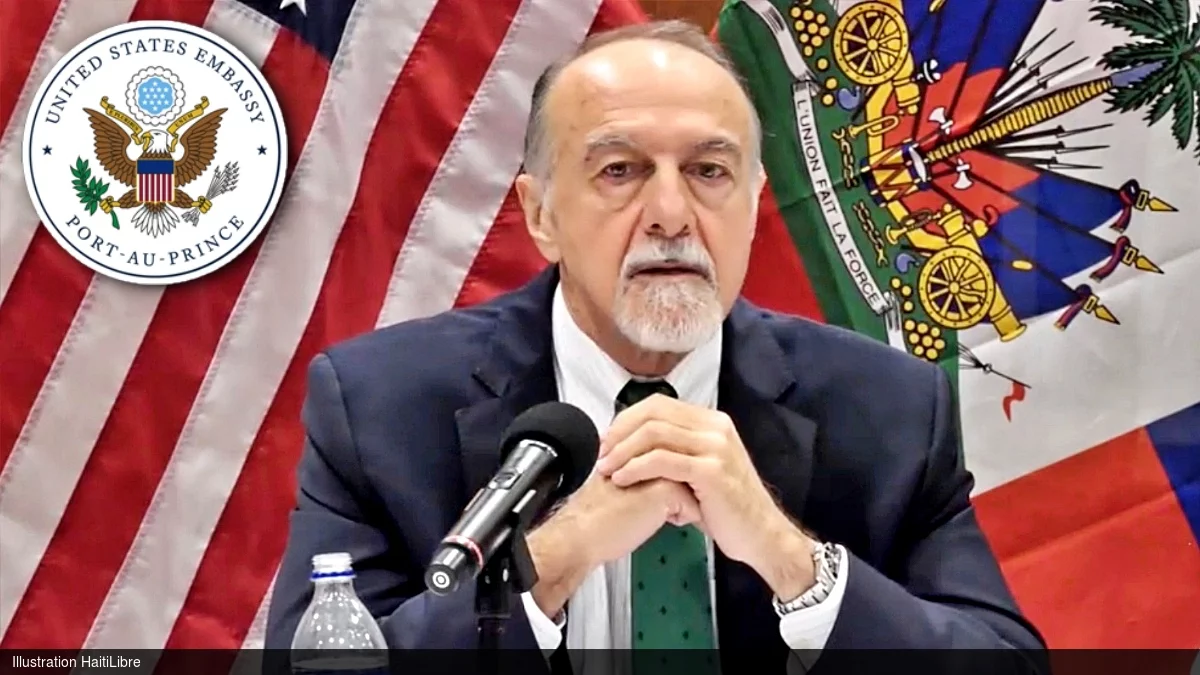
On Thursday, July 23, 2026, a few days before his departure from Port-au-Prince to Kenya, Ambassador Henry Wooster reviewed his mission, highlighting the key elements of his engagement in Haiti, the priorities for cooperation between the United States and Haiti, and the prospects for the future of bilateral relations. Text of Ambassador Wooster's statement : "Good morning, As I complete my tour in Port-au-Prince, I wanted to gather with you to reflect on our joint progress over the past year. Having served in Haiti 28 years ago and returned in June 2025, I remain inspired by the resilience, spirit, and strength of the Haitian people in the face of unprecedented challenges. Stabilizing Haiti remains the U.S. priority. Here, let me take a moment to distinguish between “security” and “stability.” While related, these terms are not synonymous: security is the narrower operational environment that fosters safe and credible elections, while stability is the longer-term product of legitimate institutions, economic growth, and effective governance. First the one—security—and then the other—stability—create the foundation to reignite Haiti’s economy, create jobs, allow children to safely return to school, and restore access to healthcare. My team here at the Embassy – and back in Washington – helps Haiti counter the existential threat posed to the survival of the Haitian state by terrorist gang networks. We worked with international partners and the UN Security Council to establish the Gang Suppression Force, or GSF. This international effort – which to date includes troops from Chad, El Salvador, Guatemala, Jamaica, Mongolia, and Sri Lanka, – began clearing operations last month. GSF is detaining gang members and turning them over to HNP for processing. GSF is seizing and destroying gangs’ weapons. They started clearing roads to retake territory for the Haitian state. These operations will expand as arriving forces deploy this summer and fall. While international support will give Haiti time and space, long-term solutions must be Haitian-led. Haitian security forces must regain capacity to defend their homeland and enforce the rule of law. Through the "P4000" program funded by the Department of State, the HNP is on its way to recruiting, training, and graduating 4,000 new officers by early 2027. The U.S. Congress lifted decades of restrictions against our cooperation with the Armed Forces of Haiti – the FAd’H – and the Haitian government is prioritizing renewal of the military with recruiting, training, and deployment in the coming months. The United States welcomes the Haitian government’s pledge to the Haitian people to return the country to democratic governance. The path ahead requires collective action from government leaders, private sector stakeholders, and civil society to reject corruption, end impunity, and work for the common good. But security and democratic governance cannot sustain stability without economic opportunity. Creating jobs is essential for individual and family survival as well as for Haiti’s economy, and to provide alternatives to youth recruitment by terrorist gangs. Haiti’s private sector must lead this effort. You cannot restore an economy to the growth rates needed to lift a people from their humanitarian crises without every business enterprise working at full capacity to expand Haiti’s foundation. In the meantime, the United States remains—by far—the largest bilateral donor to Haiti, with over $800 million in continuing assistance programs. In 2026, we provided $125 million to the OCHA-managed Humanitarian Pooled Fund, alongside $24 million for food assistance and $11 million in post-hurricane recovery support. A stable Haiti supports everyone’s interests, Haitian, American, and those of the region [...] Thank you. I look forward to your questions." HL/ HaitiLibre
|
|









|
|
Why HaitiLibre ? |
Contact us |
Français
Copyright © 2010 - 2026 Haitilibre.com |