
|
|
||||||||||||||||||


| 2026-2027 Electoral Calendar, latest official version |

|
 |
|
|
|
|
|
|
|||||
|
|
Technology revolutionizes the marking of 9th AF exams 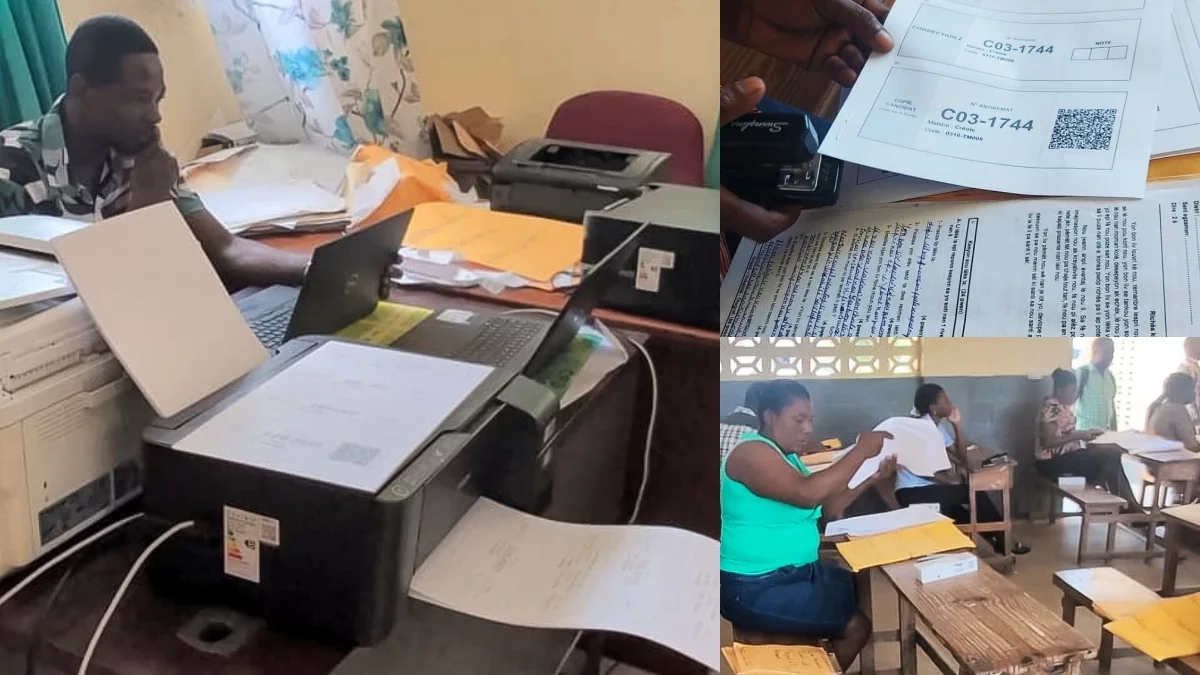
A new chapter is being written in the administration of official examinations in the Northeast Department. Under the leadership of the Departmental Directorate of Education (DDE-NE), the 2026 session of the 9th AF exams marks a break with traditional marking methods. The objective : to eliminate human error, strengthen transparency, and guarantee each candidate an assessment that accurately reflects their performance. For years, exam marking relied in part on manual processes, including writing identification codes on marking envelopes and entering grades after marking. While this system was well-managed, it remained vulnerable to transcription errors, code reversals, and data entry mistakes that could affect a candidate's final result. To definitively eliminate these risks, the DDE-NE introduced a new, fully secure marking protocol this year. The first innovation is the use of a secure and strictly confidential marking sheet, produced individually for each candidate and for each subject. This measure permanently replaces the manual writing of codes on envelopes, a practice that was one of the main sources of administrative errors. By securing the identification of exam papers from the outset, the DDE-NE strengthens the reliability of the entire marking process. The second innovation is undoubtedly the most significant. After marking, the marking grids are no longer manually transcribed into a database. They are digitized (scanned) and then automatically integrated into the computer system. This automation considerably reduces the risk of errors related to manual data entry and speeds up the processing of results. Each mark awarded by the marker is directly recorded, without any need for transcription. This development represents a major step towards a more modern, faster, and more reliable examination management system. This transformation also changes the responsibilities of the teams working at the marking center. Inspectors and operators no longer spend their time entering marks. Their mission essentially becomes one of quality control: verifying the accuracy of the digitized data, detecting any anomalies, and certifying the conformity of the results before their validation. This reorganization allows human resources to focus on quality monitoring rather than repetitive tasks, thus reducing the potential for errors. The marking process is now fully traceable. For the first time, each marker is equipped with a personal electronic badge that automatically records their arrival, departure, and the number of papers marked during each session. Thanks to this system, the Departmental Directorate has precise monitoring of all operations. Every step is traceable, every action is documented, and every person in charge can be identified with complete transparency. Beyond the modernization of procedures, this reform reflects a deeper ambition: to guarantee fairness for all candidates. In an official examination, every mark can influence a student's academic path. By minimizing the risk of human error and increasing the number of control mechanisms, the Northeast Departmental Directorate of Education (DDE-NE) aims to protect each candidate's fundamental right to receive a grade that accurately reflects their work. This approach is part of a governance vision based on innovation, transparency, and trust. For several months, the DDE-NE has been implementing numerous initiatives to digitally transform its services. Following the modernization of administrative monitoring, staff attendance tracking, and the management of educational activities, the reform of exam marking represents a new step in this process. Through this initiative, the DDE-NE demonstrates that technology is not an end in itself, but a tool for better public governance and fairer education. HL/ HaitiLibre
|
|







|
|
Why HaitiLibre ? |
Contact us |
Français
Copyright © 2010 - 2026 Haitilibre.com |