
|
|
||||||||||||||||||


| 2026-2027 Electoral Calendar, latest official version |

|
 |
|
|
|
|
|
|
|||||||
|
|
Haiti - Economy : All the details on the digitized Professional Identity Card (CIP)
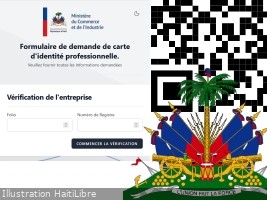
Formalizing business activity in Haiti remains a real challenge for the vast majority of economic actors. Between mobility constraints, administrative delays, and logistical obstacles, time is a scarce resource. In this context, the digital transformation of public procedures appears as a pragmatic response to concrete needs. It is worth noting that the Ministry of Commerce and Industry (MCI) launched a digital version of the Professional Identity Card (CIP) through its One-Stop Shop guichet.mci.ht/cip , as part of a modernization program supported by the Inter-American Development Bank (IDB). This reform, although partial, reveals a gradual approach to administrative modernization. A dominant informal economy :
Who is the digitalized CIP really for ? The digital version of the CIP is primarily intended for individual entrepreneurs and sole proprietorships that regularly conduct business. Specifically, this refers to individuals who buy and resell goods, provide professional or commercial services, and whose activity constitutes a source of income. However, companies constituted as legal entities (such as public limited companies or other structured business forms) are not yet integrated into the system as it currently operates. This reflects a gradual implementation rather than an immediate systemic transformation. How does the procedure work today ? Step 1 : Creating an online account. The applicant registers on the MCI's One-Stop Shop platform and creates a personal space to initiate their CIP application. Step 2 : Uploading documents. The online form requires: - National Identification Card (CIN), - Tax Identification Number (NIF), - Supporting documents for the business activity. Step 3 : Payment of fees. The application fees are paid directly on the platform via MonCash or NatCash. This option facilitates access for sole traders who already make extensive use of mobile payments, but limits the use of traditional banking channels. Step 4 : Online Tracking. The applicant can track the progress of their application via the platform. A QR code is generated and shared with the cardholder; it is printed on the physical card and allows the relevant authorities to verify the document's authenticity. Step 5 : Collection of the Physical Card. Once the application is approved, the CIP (Professional Identity Card) must be collected from the Ministry's offices. At this stage, it remains a physical document, not an electronic card or a fully digital identifier. Concrete Benefits of this System Although partial, the reform is producing tangible results:
In an economy where time, security, and transportation costs weigh on competitiveness, these gains are significant. Limitations and Structural Challenges The reform raises several important questions : Limited Scope and Sequencing : The exclusive targeting of sole proprietorships leaves the needs of more complex commercial structures unaddressed. Legal Framework for Data : Digitalization implies the collection and management of personal data. However, the Haitian legal framework for the protection of digital identity remains underdeveloped, which poses challenges in terms of security, confidentiality, and institutional trust. Diversification of payment methods : The lack of other payment methods (beyond MonCash and NatCash) limits access for some formal players accustomed to traditional banking processes. Integration with business registries : Expanded formalization will require better coordination between the Professional Identity Card (CIP), tax registries, and other business registration systems. Do not confuse the National Identity Card (CIN) and the Professional Identity Card (CIP) It is crucial for citizens not to confuse these two documents, as their functions differ legally: The National Identification Card (CIN), managed by the National Identification Office (ONI), defines civil and political identity. It is mandatory for voting and performing civil acts (marriage, property purchase, etc...); The Professional Identity Card (CIP), managed by the Ministry of Commerce and Industry (MCI), certifies a business or professional status. It is the economic formalization tool, essential for opening business bank accounts and conducting transactions with the State. HL/ HaitiLibre
|
|









|
|
Why HaitiLibre ? |
Contact us |
Français
Copyright © 2010 - 2026 Haitilibre.com |