
|
|
||||||||||||||||||


| 2026-2027 Electoral Calendar, latest official version |

|
 |
|
|
|
|
|
|
|||||||
|
|
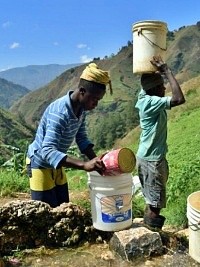
Haiti - Social : Only 43% of Haitians in rural areas have access to drinking water
According to the World Bank Only 43% of Haitians living in rural areas have access to safe drinking water, compared to 90% in the rest of Latin America and the Caribbean. The poorest communities are the most affected, with only 28% having access to basic drinking water, compared to 95% for the richest. This glaring inequality results from decades of underfunding, inadequate infrastructure and a general lack of resilience of water, sanitation and hygiene (WASH) services in the face of major natural hazards. To better understand natural hazards and climate projections on the WASH sector, assess vulnerabilities and propose concrete solutions, a technical note was produced from three spatial studies of water points identified by the National Directorate of Drinking Water and Sanitation (DINEPA). Using satellite data, studies revealed that nearly 94% of water points in Haiti are located in risk-prone areas. In particular, 32% are in drought areas, 34% in flood zones, and 28% in seismic risk areas. During disasters in these areas, populations dependent on these water points face challenges such as limited access to drinking water, increased health risks, food insecurity, social and economic disruption, and displacement. Recommendations have been developed to improve the resilience of the WASH sector in Haiti. These recommendations cover areas such as governance, infrastructure, water resource management, operational and technical capacity, coordination with key WASH sector actors, and communication with Civil Protection. To achieve this, the "Decentralized and Sustainable Rural Water and Sanitation Project", funded to the tune of $80 million by the World Bank, with technical and institutional support from the "Global Water Security and Sanitation Partnership" is implemented by DINEPA. The project recognizes that simply building new water systems is not enough. These systems must be designed to withstand the impacts of droughts, floods and earthquakes. To achieve this, the project: Risk mapping : Using satellite data, it identifies the areas most vulnerable to natural hazards, allowing for targeted interventions. Development of contingency plans : The project supports the development of contingency plans for rural water systems to ensure that communities can continue to access water even in the event of an emergency. Investing in Sustainable Infrastructure : The project incentivizes communities to build resilient and sustainable water systems, ensuring long-term access to safe drinking water. This project is already starting to make a difference. Contingency plans for 25 rural water systems, serving approximately 125,000 people, have been developed. The goal is to have 150 in place over the next five years, which would ensure access to safe drinking water for approximately 750,000 people. This is a critical step in strengthening the resilience of Haiti’s rural communities and protecting access to safe drinking water, even in the face of extreme weather events. HL/ HaitiLibre
|
|







|
|
Why HaitiLibre ? |
Contact us |
Français
Copyright © 2010 - 2026 Haitilibre.com |